Opinion · July 17, 2026

Absolutely Any Good IT Person Can Manage 150 End Users or Less, But That Number Has Nothing to Do With Cybersecurity

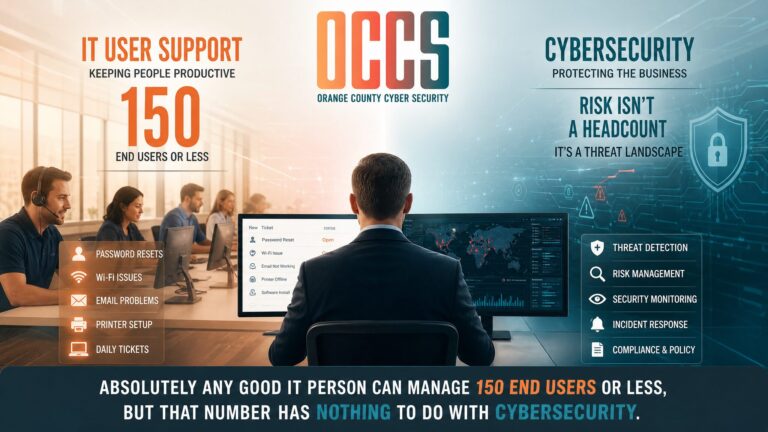
hero graphic it management vs cybersecurity

Absolutely any good IT person should be able to manage 150 end users or less, but that number describes help desk tickets, password resets, and printer jams, not stopping a ransomware attack. Some school districts run their help desks at a ratio of one IT staffer for every 700 users, a number that looks efficient on a spreadsheet until you realize none of those tickets involve a threat actor sitting inside the network for six months before anyone notices.

That gap between “manageable IT workload” and “manageable security workload” is where most Orange County small businesses get hurt. This article breaks down why the 150-user rule of thumb exists, why it was never meant to include cybersecurity, and why combining the cybersecurity task with your IT task is one of the more expensive mistakes a growing company can make.

Orange County coastline at sunset

Key Takeaways

Question Short Answer
How many users can one good IT person support? Roughly 150 end users or less for general help desk and infrastructure work, before workload and risk start compounding.
Does that 150-user ratio include cybersecurity? No. It covers tickets, patching, and basic support. It was never scoped to include 24/7 threat monitoring, incident response, or compliance work.
Why shouldn’t IT and cybersecurity be the same job? They require different skill sets, different daily priorities, and a conflict of interest when the person configuring the network is also the one auditing it. Our full breakdown of Orange County cybersecurity services covers each discipline separately for this exact reason.
What happens when a solo IT person is also “the security guy”? Coverage gaps appear fast. No backup during vacation, no dedicated monitoring, and security tasks get pushed behind whatever ticket is loudest that day.
Is OC cyber compliance different from general IT maintenance? Yes. Frameworks like NIST SP 800-171, CMMC, HIPAA, and CCPA require documented governance most generalist IT staff are never trained to produce.
What’s the fix for growing Orange County companies? Split the roles. Keep IT lean and responsive, and bring in a dedicated IT services provider or security partner for the parts IT was never built to cover.

Why “150 End Users or Less” Became the IT Benchmark

The 150-user figure isn’t a marketing number. It comes from decades of help desk staffing math, and it holds up because it’s tied to ticket volume, not headcount alone.

Industry data from help desk platform Jitbit puts the healthy planning range at one IT or support person per 75 to 100 users in a normal office environment with basic standardization and a working ticketing system. Push past 150, and that same person is stretched across onboarding, hardware, network troubleshooting, and vendor calls with no room left for anything else.

Absolutely any good IT person should be able to manage 150 end users or less if the job stays IT. The moment you ask that same person to also own firewall rules, endpoint detection, and compliance documentation, the ratio collapses.

What “IT” Actually Covers (And What It Was Never Built to Cover)

Good IT work has a clear anatomy. It’s reactive by design, and that’s fine, because that’s the job.

  • Password resets and account provisioning
  • Hardware setup, replacement, and warranty coordination
  • Printer, Wi-Fi, and network connectivity troubleshooting
  • Software installs, updates, and basic patch deployment
  • Help desk ticket triage and vendor liaison work

None of that anatomy includes threat hunting, incident containment, or building a governance framework that satisfies an auditor. That’s a different discipline, run on a different clock, with different tools entirely.

The Real Math: Tickets, Users, and Where the Wheels Come Off

User count alone doesn’t tell you the workload. A 100-person company can generate roughly 400 tickets a month, and that volume alone can consume a full-time generalist before security ever enters the picture.

Jitbit’s research also flags the danger zone directly: once a company crosses 300, 400, or 500 users with a single IT person still holding the reins, that person is often handling purchasing, security, and networking with no backup and no vacation coverage. Few business owners have actually run the math on what a gap like that costs when something breaks at 2 a.m. and nobody is covering it.

Logo

Did You Know?

Once a company grows past 300, 400, or 500 users, a solo IT person is often left handling purchasing, security, and networking alone, with no backup and no vacation coverage.
Source: Jitbit

How many users can one IT person really handle? — data from Jitbit

Reported industry ratios for users per IT support person, none of these include cybersecurity duties.

Governance, Risk & Compliance: The Job Your IT Guy Was Never Trained For

Governance, risk, and compliance work aligns your security posture with your actual regulatory obligations. HIPAA, CMMC, and CCPA all live here, and none of them get satisfied by a well-organized ticket queue.

Orange County sits in the middle of a defense and aerospace supply chain, which means plenty of local contractors are now facing CMMC Level 1 and Level 2 requirements they didn’t have to think about a few years ago. Getting the compliance level right matters, because scoping wrong is how businesses either overspend on controls they don’t need or fail to protect the controlled unclassified information they’re actually required to guard.

That’s specialized work. Our governance, risk, and compliance services exist because that documentation and audit trail is a full discipline on its own, not a side task for whoever already fixes the office printer.

Identity & Access Management: Where Combined Roles Break First

Identity and access management decides who gets into what, and when. MFA, single sign-on, role-based access, and privileged access management all sit inside this discipline.

Here’s the conflict most owners don’t see coming. When the same person who manages daily logins is also the one auditing access privileges, there’s no second set of eyes catching the account that should have been deactivated three months ago.

That’s not a knock on any individual IT person’s competence. It’s a structural problem, and it’s exactly why identity and access management gets treated as its own lane rather than a bullet point on a general IT job description.

Security Operations: Why Monitoring Can’t Be a Side Job

Security operations means 24/7 monitoring, incident response, threat intelligence, and system hardening running continuously, not whenever there’s spare time between tickets. Attackers don’t wait for business hours, and neither should detection.

Ransomware is hitting Orange County small businesses hard, and the pattern is almost always the same. Nobody was watching the network closely enough to catch the lateral movement before encryption started.

The nationwide scale of modern threats makes the point clearly. The Salt Typhoon cyberespionage campaign alone touched over 600 organizations across 80 countries, a scope that no single generalist IT hire, however talented, is staffed or trained to watch for while also resetting passwords all day.

Did You Know?

The Salt Typhoon cyberespionage campaign impacted over 600 organizations across 80 countries, a scale no generalist IT hire is staffed to monitor alone.
Source: Forrester via Forbes

That’s why security operations needs to run as its own function, staffed and watched around the clock, separate entirely from whoever answers the daily IT help desk line.

Security Architecture & Engineering: Built In, Not Bolted On

Security architecture builds protection into systems from the start, using defense-in-depth and zero-trust principles rather than patching holes after the fact. Cryptography, PKI, and hardware hardening all live here, and they require design decisions made before a system goes live.

Analysts at Forrester expect quantum security spending alone to reach 5% of the overall IT security budget by 2026, which tells you how fast this specialty is moving beyond what a generalist IT stack can keep pace with. Our security architecture and engineering work exists precisely because secure-by-default design isn’t a task you add to a Tuesday afternoon.

Orange County Cybersecurity: Generalist IT Shops vs. Dedicated Security Providers

Orange County has no shortage of IT shops. Irvine to Anaheim, and every city in between, is full of capable generalist providers who keep networks running and printers printing.

What’s rarer is a firm that treats Orange County cybersecurity as its own engineering discipline rather than a checkbox added to a managed services contract. That distinction is exactly why our provider directory separates general IT companies from firms that specialize in security-first work.

OC cyber compliance work, whether it’s CMMC for a defense subcontractor in Lake Forest or CCPA obligations for a retailer in Aliso Viejo, requires documentation and technical controls that a generalist help desk contract was never scoped to deliver. Browsing our IT services category next to our managed services category makes the split obvious fast: some providers manage endpoints, and some manage risk, and the good ones are honest about which lane they’re in.

Getting the level right matters, because scoping wrong is how businesses either overspend on controls they don’t need or fail to protect what they do.

Data Security Orange County: Why the Balance Sheet Should Drive This Decision

Consumer expectations have shifted too. A Deloitte survey of 4,000 US consumers found people increasingly expect the companies they buy from to actively prioritize data privacy and security, not treat it as an afterthought bolted onto general IT.

The number that matters here isn’t a scary national headline. It’s the realistic, fully loaded cost of an incident at a company your size, and that number gets worse every year a business treats IT + cybersecurity as one interchangeable job.

Data security Orange County businesses actually need looks less like “add security to the IT contract” and more like a dedicated build-out, run on its own schedule, with its own guardrails. The worst time to calculate the cost of a breach is after one.

How to Know You’ve Outgrown the “One Person Does Everything” Model

There are warning signs long before a breach forces the issue.

  • Your IT person is also configuring the firewall and reviewing the logs
  • Nobody can name your last access review or patch audit
  • Security tasks get “whenever there’s time” instead of a dedicated schedule
  • You’ve crossed 150 users and IT is starting to visibly fall behind
  • Compliance deadlines (CMMC, HIPAA, CCPA) are approaching with no documented plan

If two or more of those sound familiar, the compliance clock is already ticking. The businesses that treat this as a fire drill next year will lose ground to the ones treating it as a build-out now.

Conclusion

Absolutely any good IT person should be able to manage 150 end users or less, and that’s a fair, well-earned benchmark for general IT support. But it does not include cybersecurity, and pretending otherwise is how growing Orange County businesses end up under-protected exactly when they can least afford it.

Separating the two isn’t about distrust in your current IT staff. It’s about giving each discipline the dedicated attention it was designed for, whether that’s ticket resolution or 24/7 threat monitoring.

Keep your IT team focused on the 150-user workload it’s built for, and bring in a dedicated Orange County cybersecurity partner for the rest. That split, more than any single tool or policy, is what actually keeps a company off the breach report next year.

Frequently Asked Questions

How many end users can one IT person realistically support?

Most industry benchmarks put the healthy range at 150 end users or less for general help desk and infrastructure work, based on a ratio of roughly one support person per 75 to 100 users in a standardized environment. That number covers tickets, hardware, and basic troubleshooting, not security monitoring.

Should cybersecurity be part of my IT department’s job in 2026?

No. Combining IT + cybersecurity into one role creates coverage gaps, conflicts of interest in access reviews, and burnout once ticket volume alone hits 400 a month. Dedicated security functions like SecOps and GRC need their own staffing and schedule.

What’s the risk of one person handling both IT and security?

Once a company crosses 300 to 500 users, a solo generalist is often left managing purchasing, networking, and security with no backup and no vacation coverage. That’s the exact staffing gap attackers count on.

Is Orange County cybersecurity different from standard IT support?

Yes. Orange County cybersecurity work covers governance and compliance, identity and access management, security operations, and architecture design, all disciplines that require dedicated training beyond general help desk skills.

What does OC cyber compliance actually require from a small business?

OC cyber compliance typically means documented alignment with frameworks like HIPAA, CMMC, or CCPA, including access reviews, incident response plans, and audit-ready records, none of which a general IT ticketing workflow produces on its own.

How do I know if my business has outgrown its current IT setup?

If you’ve crossed 150 users, can’t name your last access review, or handle security tasks only “when there’s time,” you’ve likely outgrown the one-person model and need a dedicated data security Orange County partner.

Is it worth separating IT and cybersecurity budgets in 2026?

Yes. Quantum security spending alone is projected to reach 5% of overall IT security budgets by 2026, showing how specialized and cost-intensive modern security has become compared to standard IT maintenance.